CHAPTER 9
Where Cracks Meet Crust
“Sometimes becoming someone is stranger than being nobody.”
Strawbrawler was beginning to learn that having a name came with consequences.
Mostly, people used it.
“Strawbrawler!”
He turned.
A nut vendor across the street lifted one hand.
Strawbrawler hesitated, then waved.
The vendor returned to arranging paper cones of roasted almonds as though nothing unusual had happened.
Strawbrawler continued walking.
Half a block later, he glanced back.
The vendor was serving someone else.
That was it.
No fight.
No crowd.
No one demanding anything.
Someone had simply known who he was.
Strawbrawler was not sure why that felt so strange.
For most of his life, the only desserts who knew him were the ones he lived with.
Then he had left the children’s home and discovered that Pastrypolis was very large and cared very little whether one small strawberry cheesecake existed inside it.
Now complete strangers called his name.
He still had not decided which experience was more unsettling.
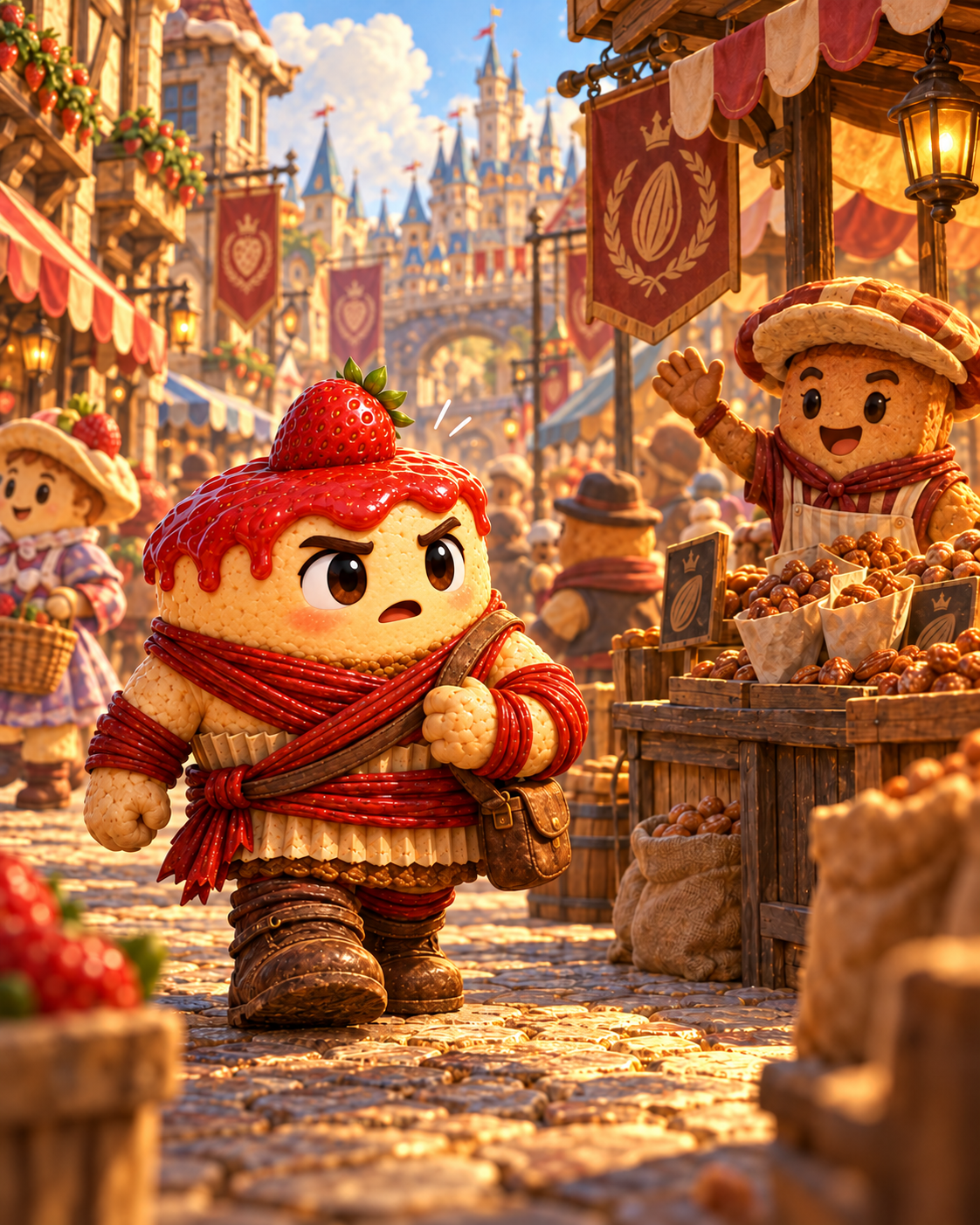
He adjusted the strap of the small satchel over his shoulder.
Éclair had sent him into the city with errands.
Lamp oil.
Cord.
Soap.
Salt.
The last item had been heavily underlined.
NORMAL SALT.
Beneath it:
THE GROCER WILL LIE TO YOU.
Strawbrawler had asked what that meant.
Éclair had responded:
“You’ll see.”
Strawbrawler suspected this was less wisdom than an old disagreement.
A pair of young pastries passed him.
One whispered something.
The other looked over.
Strawbrawler heard his name.
He pretended not to.
That was becoming useful.
He found the grocer three streets later.
The grocer was a broad molasses cookie with a white apron and the confident expression of someone who believed every customer secretly wanted something more expensive than what they had requested.
“Salt,” Strawbrawler said.
“Of course.”
“Normal salt.”
The grocer paused.
“Have you tried smoked caramel salt?”
Strawbrawler closed his eyes.
“No.”
“Wonderful depth.”
“I need normal salt.”
“Perfect for stews.”
“Normal.”
“Roasted vegetables.”
“Normal.”
“Certain glazes—”
“Normal salt.”
The grocer stared at him.
Strawbrawler stared back.
Finally the grocer sighed.
“Young desserts fear complexity.”
Strawbrawler paid and put the packet into his bag.
He understood Éclair now.
That was worrying.
Outside, he checked the rest of the list.
Lamp oil next.
He had almost reached the corner when a pair of compact red boots in a narrow cobbler’s window caught his eye.
Strawbrawler had not meant to buy boots.
Strawbrawler looked at them.
Then kept walking.
Three steps.
He stopped.
Turned around.
Looked again.
They were not fancy.
That was what caught him.
No polished buckles.
No bright metal.
No decorative trim.
Just sturdy little boots made from dark red reinforced material, broad through the base and shaped for a compact dessert stance.
Practical.
Strawbrawler looked down at his own boots.
They were still holding.
Mostly.
The left sole had begun separating near the heel.
One lace had been replaced with cord.
The right boot carried a stain from something Éclair had insisted was pudding.
Strawbrawler remained unconvinced.
He looked back at the red pair.
Then at the red wrap crossing his shoulder.
The color matched.
Almost.
That somehow made the decision harder.
He entered the shop.
A biscuit cobbler looked up from behind the counter.
“Need something repaired?”
Strawbrawler glanced down.
“Probably.”
The cobbler leaned sideways to see his boots.
“Definitely.”
Strawbrawler pointed toward the window.
“Those.”
The cobbler followed his hand.
“The red pair?”
“Yes.”
“You want to try them?”
Strawbrawler hesitated.
“How much?”
The cobbler told him.
Strawbrawler’s expression changed.
“That much?”
“They’re boots.”
“I noticed.”
“Good boots.”
“That is still a lot.”
The cobbler shrugged.
“Bad boots are cheaper.”
Strawbrawler looked down again.
That sounded suspiciously like something Éclair would say.
He did not like that.
“Can I try them?”
The cobbler brought them over.
Strawbrawler sat on a low fitting bench and pulled off his old pair.
For a moment, he simply held one.
The leather-like material was creased.
Scuffed.
Worn thin around the sole.
They had carried him out of the children’s home.
Through eight job rejections.
Across the city.
Into a loading alcove.
Down the wrong grate.
Through training.
Through Slice.
There was nothing wrong with them except that they were nearly finished.
Strawbrawler set them carefully beside the bench.
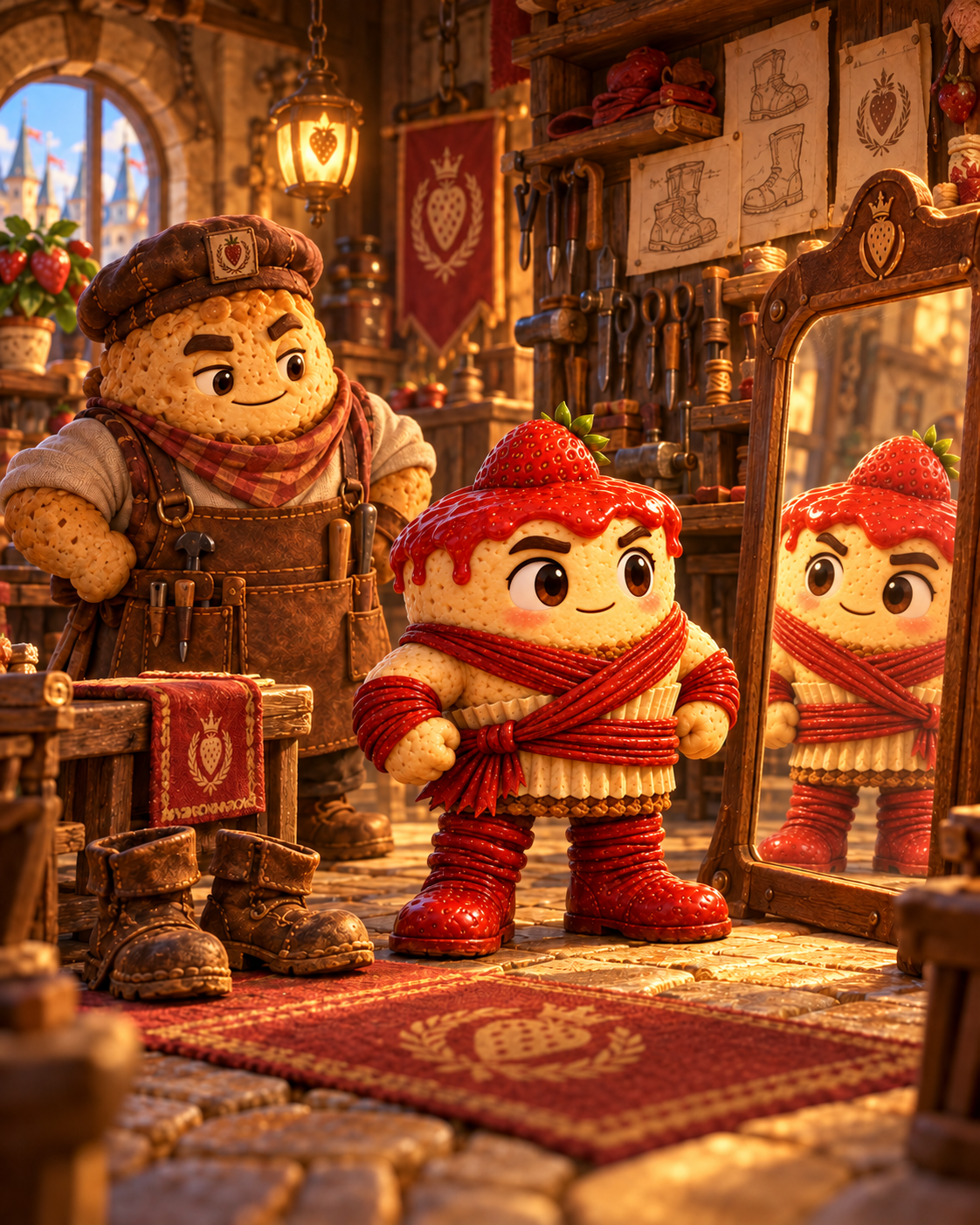
Then pulled on the red boots.
He stood.
Too stiff.
He frowned.
Took two steps.
Shifted his weight.
Planted.
The boots held.
He widened his stance slightly.
Better.
The cobbler watched.
“Planning to walk in them or fight the floor?”
“Both.”
The cobbler nodded as though this were perfectly reasonable.
Strawbrawler pivoted once.
No pinching.
No slipping.
His feet stayed where he put them.
That mattered.
He looked toward the small mirror beside the counter.
Red shoulder wrap.
Red waist wrap.
Wrapped wrists.
Red boots.
The outfit looked more complete now.
Not designed.
Not assembled all at once.
Built.
One decision at a time.
The cobbler noticed where he was looking.
“Color suits you.”
Strawbrawler looked away.
“They fit.”
“Didn’t say they didn’t.”
Strawbrawler paid.
It hurt.
Not physically.
He counted the remaining coins twice.
Then looked at the old boots.
“You throwing those out?”
The cobbler asked.
Strawbrawler picked them up immediately.
“No.”
He tucked them into his satchel.
The cobbler raised one brow.
“Sentimental?”
“No.”
A pause.
“Maybe.”
He stepped back onto the street.
The new boots felt strange.
Firm.
Reliable.
Every step sounded slightly different against the paving stones.
Strawbrawler walked half a block before realizing something.
He had bought them because he expected to use them.
Not today.
Not just for training.
For later.
For roads he had not walked yet.
He looked down once at the red boots.
Then remembered the list.
“Lamp oil.”
He turned toward the next shop.
He had not gone far when someone called
“Strawbrawler!”
He turned again.
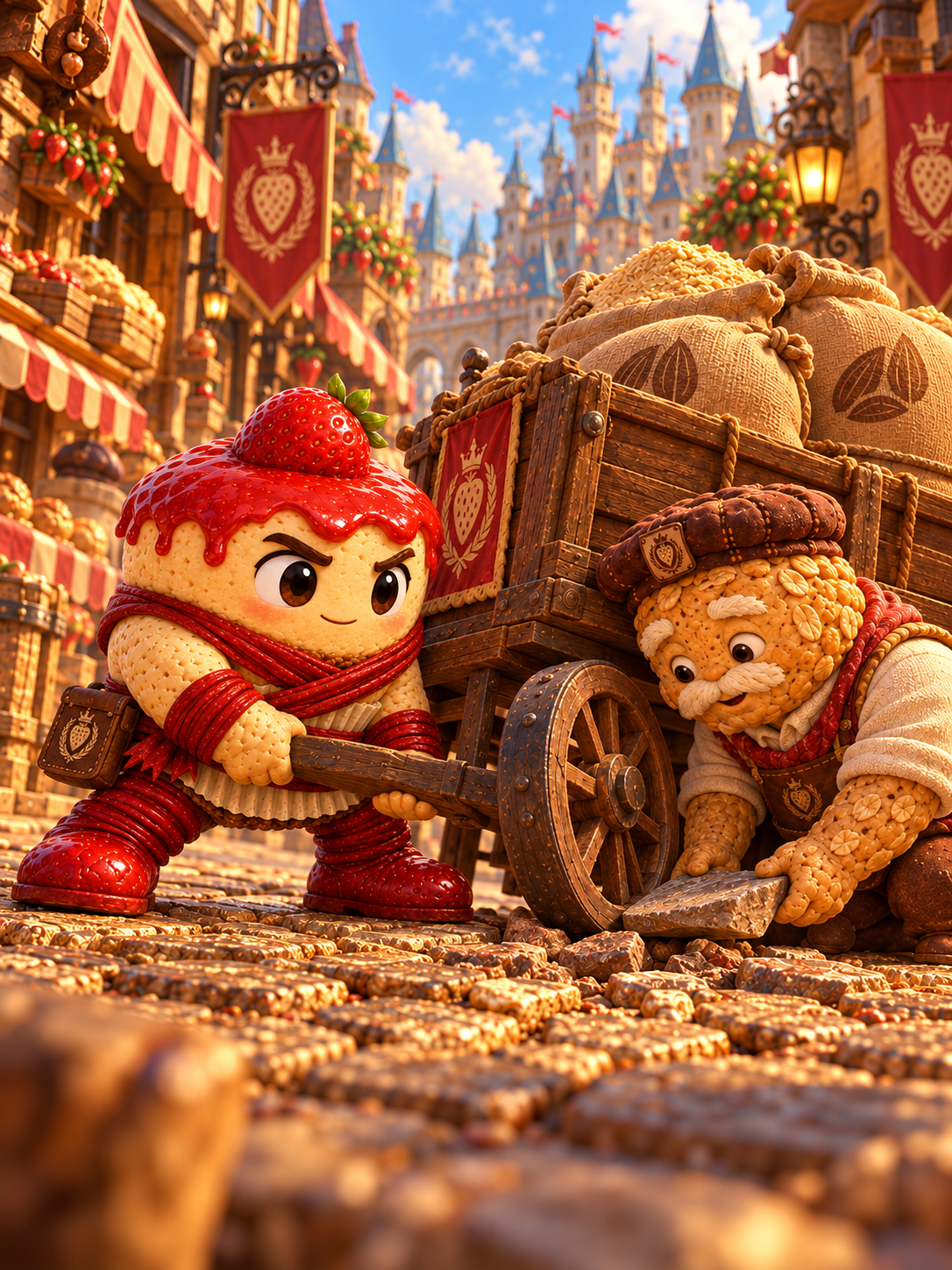
An elderly oat biscuit was crouched beside a handcart.
One wheel had settled into a broken patch of paving.
The cart was loaded with sacks of almond meal.
“Could use that famous strength.”
Strawbrawler stiffened.
The biscuit laughed.
“Relax. I’m joking.”
“Oh.”
“Mostly.”
Strawbrawler walked over.
The wheel had sunk nearly to its hub.
“I can lift this side.”
“That was my hope.”
Strawbrawler crouched.
Hands beneath the frame.
He started to pull.
Stopped.
Éclair’s voice appeared in his head.
Base first.
Strawbrawler shifted his feet.
Lowered his center.
Tried again.
The cart rose.
Not easily.
But steadily.
The biscuit shoved a flat stone beneath the wheel.
“A little more.”
Strawbrawler pushed harder.
Something warm stirred beneath his crust.
A tiny pressure.
Almost familiar.
Then it disappeared.
“There.”
The biscuit stepped back.
Strawbrawler lowered the cart carefully.
The wheel held.
“Thank you.”
“No problem.”
The biscuit reached into one of the sacks and handed him a folded twist of roasted almond crumbs.
Strawbrawler looked at it.
“You don’t have to pay me.”
“I know.”
Strawbrawler paused.
The biscuit shrugged.
“I want to.”
Something about that stopped the refusal before it reached Strawbrawler’s mouth.
He took the packet.
“Thanks.”
The biscuit nodded.
Strawbrawler started away.
“Hey.”
He turned.
The biscuit smiled.
“Good fight.”
The warmth vanished.
“Oh.”
The biscuit noticed.
“Not because you won.”
Strawbrawler looked back at him.
“Then why?”
“You stopped.”
The biscuit returned to his cart.
Strawbrawler remained there another moment.
Then continued walking.
He opened the almonds.
They were good.
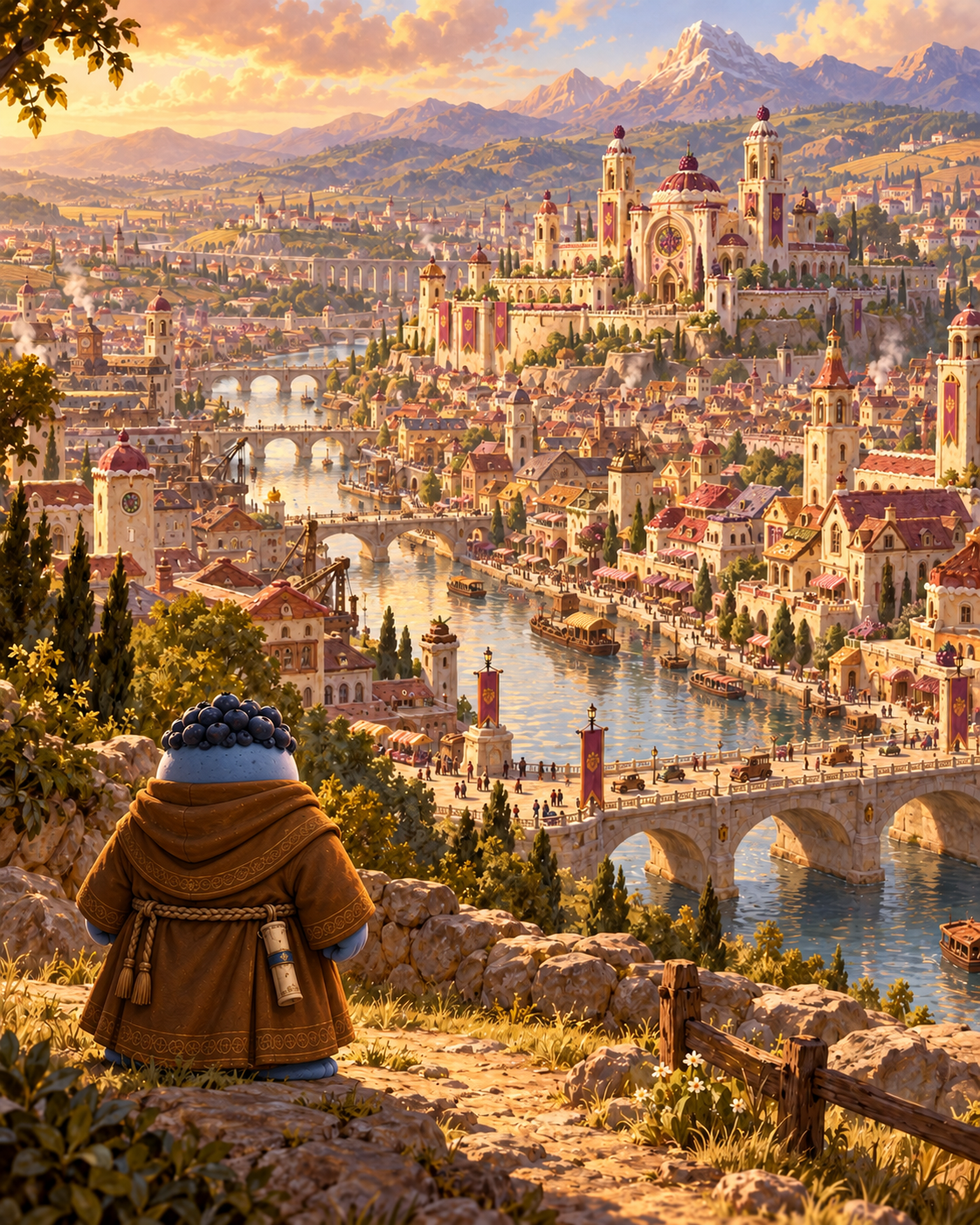
Blue Bulk reached Pastrypolis several days later, shortly before noon.
He stopped where the mountain road widened enough to reveal most of the city.
Pastrypolis spread through the valley below him.
Old roofs crowded around church towers and civic buildings.
Newer streets reached outward.
The Glazewater divided districts before continuing toward the western country.
Traffic moved across bridges.
Smoke curled from workshops.
Carriages, handcarts, powered vehicles, and pedestrians filled the roads.
Blue Bulk stood quietly.
A driver guiding a small mule cart slowed beside him.
“First visit?”
Blue Bulk nodded.
“Big city.”
“Yes.”
“You heading in?”
“Yes.”
The driver waited.
Nothing followed.
Eventually he clicked to the mule.
“Monks.”
Blue Bulk watched him go.
Then returned his attention to Pastrypolis.
The city was loud.
Not with sound.
With pressure.
Thousands of feet moved across stone.
Wheels compressed roads.
Water ran beneath streets.
Foundations shifted fractions against one another.
Heat expanded old pipes.
Buildings carried their own weight downward into buried stone.
To most desserts, Pastrypolis was streets, towers, markets, homes.
To Blue Bulk, it was also an enormous arrangement of forces.
And somewhere inside it—
Thum.
His eyes opened slightly wider.
There.
Very faint.
Blue Bulk waited.
Nothing.
He started walking.
At Cheesecake Emergency Services, nothing happened.
Then something happened.
Whip Siren noticed first.
She had been recalibrating one of the old structural monitors when its needle moved two marks to the right.
She stopped.
The needle returned.
Glazey Dave was beneath the neighboring console with both feet sticking into the aisle.
“Dave.”
“Mmm?”
“Come out.”
“Is this urgent?”
“I don’t know.”
“That usually means yes.”
He rolled backward.
His goggles were on his forehead.
A screwdriver sat between his teeth.
Whip pointed.
The needle moved again.
Dave removed the screwdriver.
“That’s rude.”
Whip looked at him.
“The needle?”
“It waited until I put everything back together.”
Captain Crumble entered from the operations floor.
“What?”
Whip pointed toward the instrument.
“Lower array.”
Crumble approached.
“Location?”
“Not enough amplitude yet.”
The needle moved again.
Slightly farther.
Dave leaned closer.
“Same range as the Lower Pastrypolis event?”
Whip checked the previous chart.
“Possibly.”
Crumble looked at the city map.
“Log it.”
Whip was already writing.
Dave adjusted the monitor.
“You want sensitivity increased?”
“No.”
He stopped.
Crumble continued.
“Not until we know whether we’re measuring the city or the instrument.”
Dave nodded.
“See? This is why you’re captain.”
“I know.”
Dave looked at Whip.
“She does know.”
Whip ignored him.
The needle stopped.
Crumble waited another ten seconds.
Nothing.
“Continue calibration.”
She turned away.
Dave looked back at the monitor.
“I don’t trust you.”
Whip glanced over.
“It’s brass.”
“That has never stopped anything.”
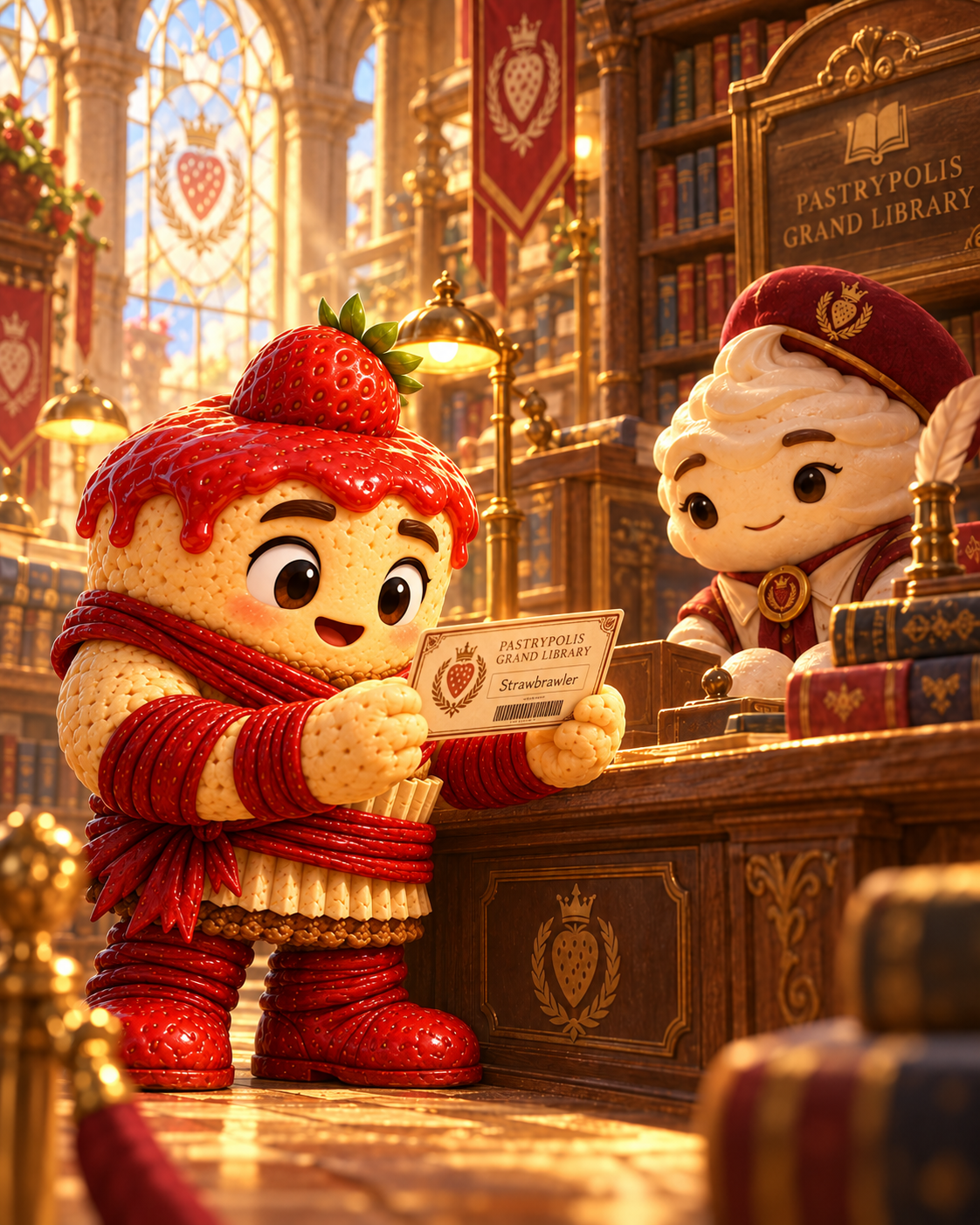
Strawbrawler reached the library after lunch.
The same building had seemed larger when he was younger.
He remembered sitting near the children’s section with two other residents while a volunteer read aloud from an adventure story about an explorer crossing the eastern forests.
Back then, he had assumed adults always knew where they were going.
He knew better now.
He placed Éclair’s book on the counter.
The clerk checked the card.
“You owe two crumbs.”
Strawbrawler’s stomach tightened.
Then he remembered.
He had money now.
Not much.
But some.
He reached for his pouch.
The clerk looked again.
“Oh.”
Strawbrawler stopped.
“What?”
“This was borrowed through the children’s home.”
She marked the line.
“No charge.”
“Oh.”
Strawbrawler lowered his hand.
The clerk glanced up.
“Are you still residing there?”
“No.”
The word came sharper than he intended.
She did not react.
Strawbrawler felt foolish.
“Sorry.”
“No need.”
The clerk turned the record around.
“You’ll need a personal card if you’re borrowing independently now.”
Strawbrawler blinked.
“A personal card?”
“Yes. Do you have identification?”
He did.
Those papers again.
The papers that had told employers things about him before he could tell them himself.
He slowly took them from his satchel.
The clerk checked each one.
Her eyes moved across the old intake notation.
Slightly imperfect.
Nothing happened.
No expression.
No pause.
She simply continued.
Then she pulled out a blank library card.
“Name?”
Strawbrawler looked at the line.
NAME
For years, there had never been much choice about what anyone called him.
Then for a while, he had barely felt like anyone at all.
Now the answer came easily.
“Strawbrawler.”
The clerk wrote it.
Stamped the card.
Slid it across the counter.
“There.”
Strawbrawler picked it up.
STRAWBRAWLER
His name.
On something official.
He turned it over.
Then back.
The clerk smiled slightly.
“You can use it today.”
“Oh.”
Strawbrawler looked toward the shelves.
“I wasn’t planning to—”
He stopped.
Maybe he could.
Nobody was telling him what he had to read.
Nobody was assigning anything.
It was simply his card.
“I’ll look.”
He left twenty minutes later with a borrowed book tucked carefully inside his bag.
Blue Bulk entered the outer districts.
He walked slowly.
Not because he could not move faster.
Because cities deserved listening.
A cracked drain cover caught his attention.
He stopped.
Pressed one hand lightly against it.
Loose bedding below.
Water erosion.
A shopkeeper watched from a doorway.
“Problem?”
“Eventually.”
“That is not comforting.”
“Before winter.”
The shopkeeper sighed.
“I’ll report it.”
Blue Bulk nodded.
Then stopped.
Thum.
Stronger.
Southwest.
No—
Closer to west.
He turned.
The shopkeeper followed his gaze.
“What?”
Blue Bulk listened.
Nothing.
Then another small pressure wave.
Not geological.
Not entirely.
The sensation carried intention in a way stone did not.
That troubled him.
Or interested him.
He was not yet sure which.
Blue Bulk walked toward it.
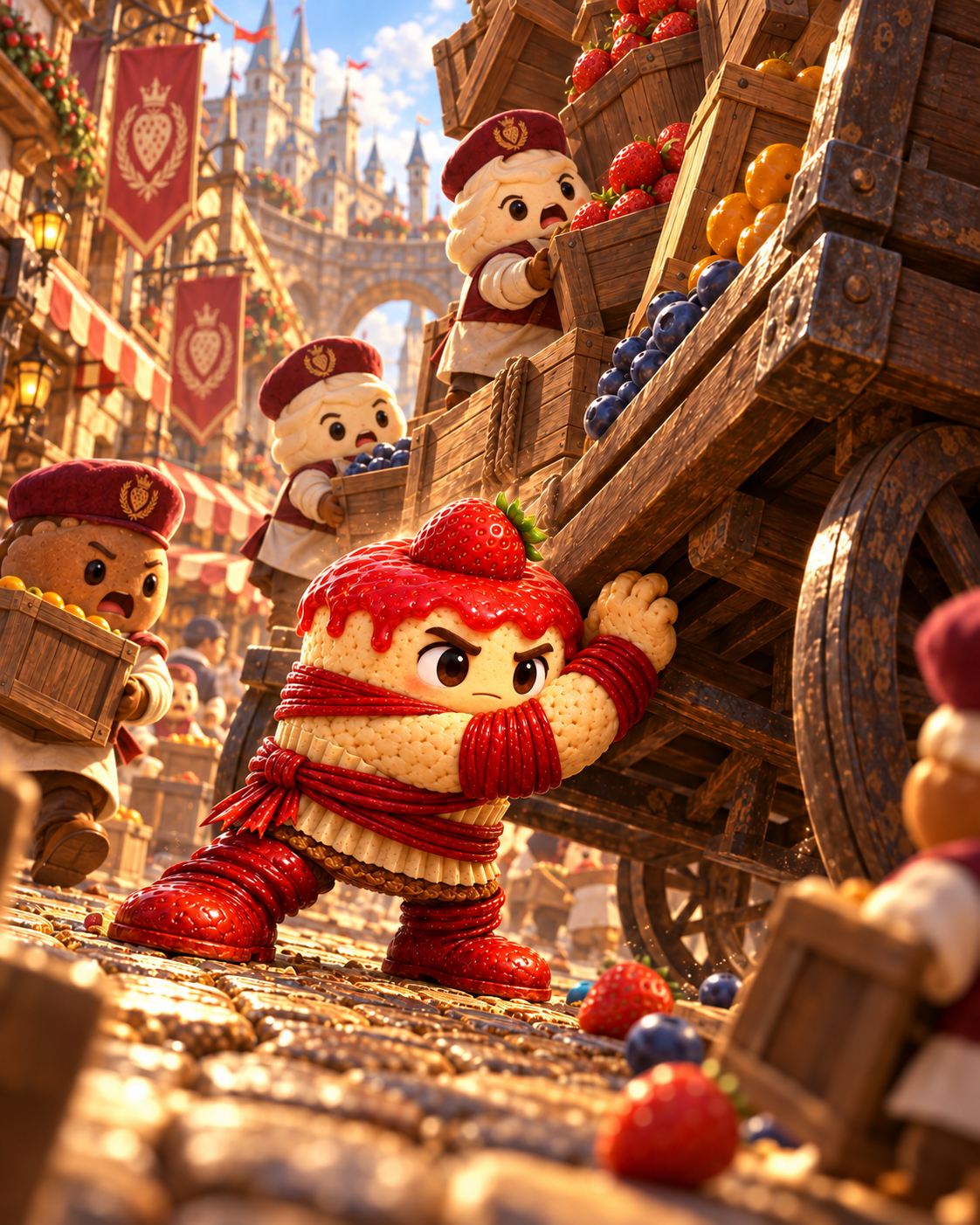
Strawbrawler was halfway back to Éclair’s underground rooms when the produce wagon failed.
The first sound was wood snapping.
Then shouting.
Strawbrawler turned.
A loaded wagon had dropped sharply onto one side.
One rear wheel sat crooked beneath it.
Crates leaned dangerously toward the street.
Three workers pushed against the wagon while another tried to pull smaller boxes away.
A child stood too close.
His mother grabbed him backward.
Strawbrawler dropped his satchel beside a doorway and ran over.
“What happened?”
“Axle pin!”
A worker strained against the wagon.
“It’s going!”
Strawbrawler took the low side.
“I’ll hold it.”
The worker looked at his size.
Then his face.
Recognition.
“Strawbrawler?”
“Doesn’t matter. Move the crates.”
Strawbrawler pushed.
The wagon barely moved.
He reset his feet.
Base first.
Again.
The load settled against him.
Heavy.
Far heavier than the cart from earlier.
His arms shook.
“Go!”
The workers started unloading.
One crate.
Then another.
Strawbrawler felt the pressure beneath his crust.
Warm.
Growing.
Thum.
He inhaled sharply.
The wagon rose a fraction.
Heat shimmered above the strawberry glaze around his head.
Nobody noticed.
They were too busy moving crates.
The pressure grew.
Forward.
Down.
Out.
Strawbrawler remembered Slice.
The strike.
The instant when everything had concentrated and then—
released.
For a moment his body wanted to do the same thing.
Push.
Explode outward.
Force the wagon away.
But there were people beside him.
Crates behind him.
A child nearby.
He did not need to hit anything.
He needed to hold.
Strawbrawler changed his stance.
Not much.
Just enough.
The pressure shifted.
The heat remained.
But instead of bursting outward, it seemed to settle through him.
Into his feet.
Into the road.
The wagon stopped sinking.
One worker stared.
“Keep moving!” Strawbrawler shouted.
They did.
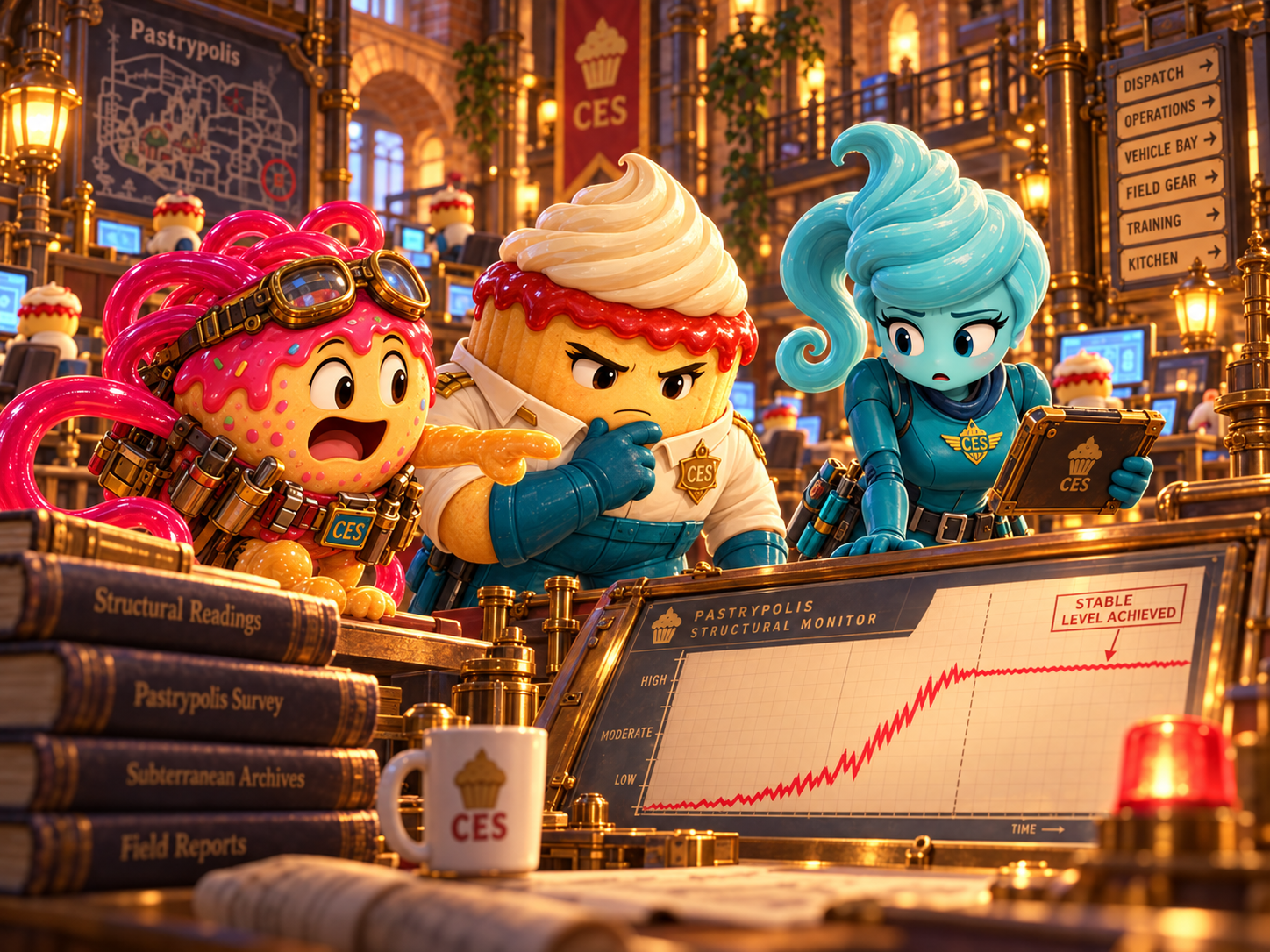
At CES, the needle jumped.
Whip Siren spun toward it.
“Crumble!”
Captain Crumble was there seconds later.
“How high?”
“Still rising.”
Dave rolled another chart beside it.
“That is the same area.”
“Confirm.”
Whip adjusted the location board.
“Lower Pastrypolis. Three-block uncertainty.”
The needle climbed.
Crumble watched.
“Rate?”
“Increasing.”
Dave stopped joking.
“Fast.”
Whip looked at him.
“How fast?”
“Enough.”
Crumble’s eyes remained on the trace.
“Prepare response.”
Whip was already reaching for her field kit.
Then the needle changed.
Not stopped.
Changed.
Its rapid climb slowed.
The line being drawn across the chart flattened.
Whip froze.
Dave leaned closer.
“That’s new.”
Crumble held up one hand.
Nobody moved.
The line continued.
Elevated.
Steady.
Then gradually declined.
Whip looked at the old record.
“The previous Lower Pastrypolis event discharged sharply.”
Crumble nodded.
“This one didn’t.”
Dave pointed.
“Same general range. Different behavior.”
“Location holding?”
“Approximately.”
Crumble looked toward the deployment board.
Whip understood.
“We going?”
Crumble did not answer immediately.
“Any distress calls?”
The dispatcher checked.
“One traffic obstruction. Produce wagon failure.”
“Injuries?”
“None reported.”
“Structural collapse?”
“No.”
“Fire?”
“No.”
Dave tilted his head.
“So our mystery earthquake might be helping vegetables.”
Crumble looked at him.
“You have no evidence of that.”
“I said might.”
Whip glanced back at the trace.
“What if it spikes again?”
“Then we respond.”
Crumble looked toward the city map.
“For now, we observe.”
Dave looked surprised.
“You’re not curious?”
“Very.”
“That is usually when you become frightening.”
“I am not sending an emergency team into a crowded street because an old brass needle moved.”
Dave nodded.
“That is disappointingly reasonable.”
Crumble pointed toward the chart.
“Get me everything from that block.”
“Everything?”
“Calls, maintenance requests, transport incidents, street reports.”
Dave looked at Whip.
“She said everything.”
Whip was already working.
“I heard her.”
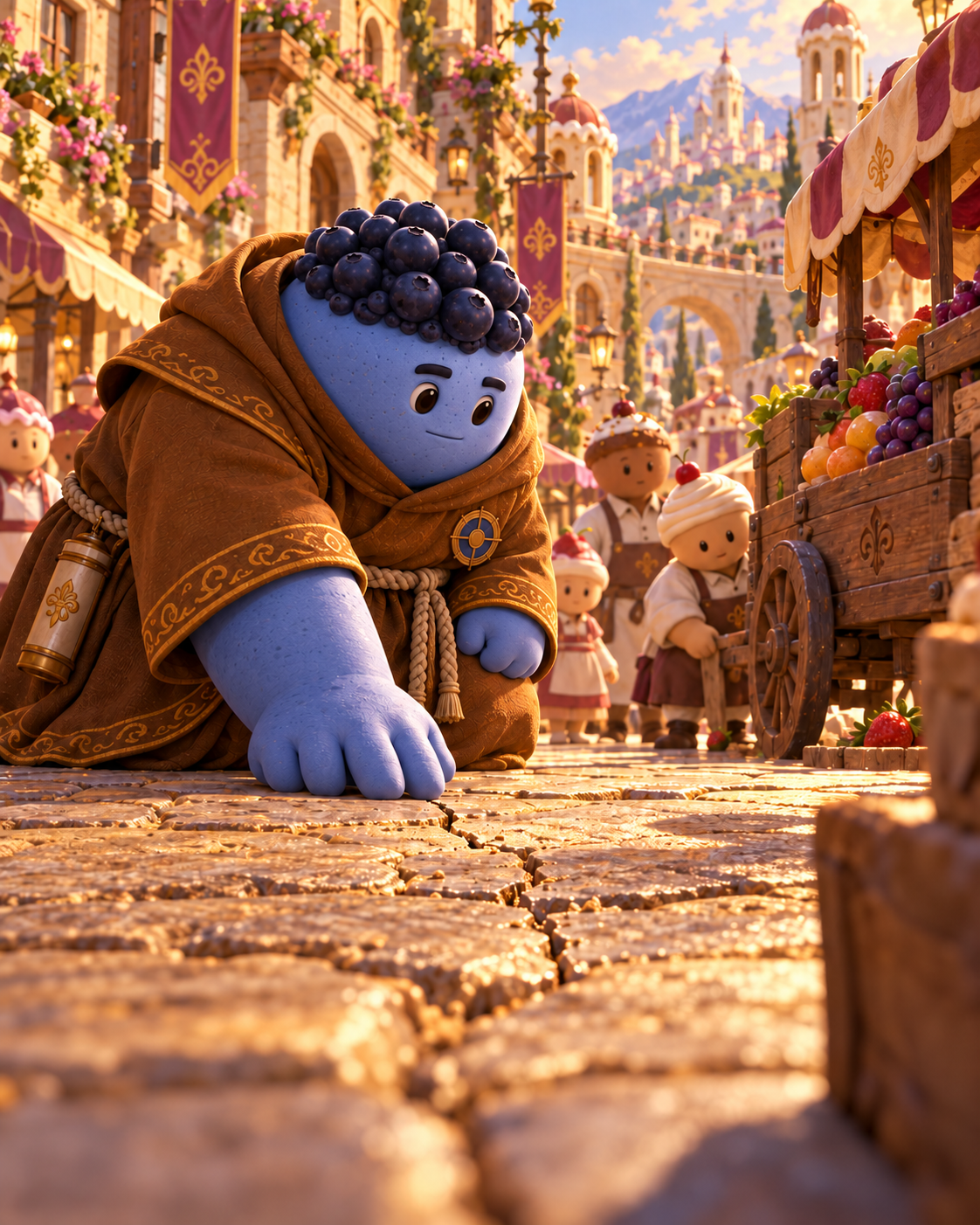
Blue Bulk felt the resonance change.
He stopped in the middle of a crossing.
Someone behind him complained.
Blue Bulk moved aside.
The pressure had been building toward release.
He knew that sensation.
Uncontrolled force often behaved that way.
So did panic.
So did collapsing structures.
But then—
it had changed.
Not vanished.
Redirected.
Contained.
Imperfectly.
But deliberately.
Blue Bulk turned toward the source.
And for the first time since leaving the monastery, he quickened his pace.
Strawbrawler lowered the wagon.
Slowly.
The last crate had been moved.
The broken axle settled against the paving.
He stepped away.
His arms trembled.
One of the workers slapped him lightly on the shoulder.
“That was something.”
Strawbrawler looked at the stone beneath his feet.
A thin crack ran between two paving blocks.
He crouched.
Touched it.
Warm.
His stomach dropped.
“I did that.”
The worker looked.
“That?”
“The crack.”
“It was probably already there.”
“It wasn’t.”
“How do you know?”
Strawbrawler opened his mouth.
Closed it.
“I don’t.”
“Then I blame the wagon.”
The worker turned back toward the others.
Strawbrawler remained crouched.
The warmth beneath his crust was already fading.
Why had it been different?
He had felt the same pressure as before.
But this time he had stopped it.
No.
Not stopped.
Changed.
He rubbed one hand against the paving.
Nothing answered.
Someone called his name from beside the wagon.
“Strawbrawler!”
He looked up.
“Thank you!”
He raised one hand.
Then grabbed his satchel and left.
He suddenly wanted Éclair.
Not because Éclair would know.
He probably wouldn’t.
But Éclair was very good at looking unimpressed while Strawbrawler explained impossible things.
That was comforting.
Blue Bulk reached the street four minutes later.
The wagon remained.
Workers remained.
Crates lined the pavement.
The young cheesecake did not.
Blue Bulk stopped at the crack.
He crouched.
One hand against the stone.
Warm.
Residual pressure lingered in the paving.
Disorganized.
Young.
Powerful.
Blue Bulk closed his eyes.
There was something else.
Not in the stone.
A direction.
Fading.
He stood.
“Excuse me.”
One of the workers turned.
“Yes?”
“Who held the wagon?”
The worker smiled.
“You missed him.”
“Who?”
“Strawbrawler.”
Blue Bulk repeated it quietly.
“Strawbrawler.”
“Yeah. Strawberry cheesecake. Short fellow. Hard to miss once you know him.”
Blue Bulk looked down the street.
“How long ago?”
“Few minutes.”
“Which way?”
The worker pointed.
Blue Bulk nodded.
“Thank you.”
He continued.
Behind him, the worker watched.
“Monks,” he muttered.
At CES, Dave placed the first public report onto Crumble’s table.
“Produce wagon.”
Crumble read.
“Axle failure.”
“No injuries.”
“Why is this relevant?”
Dave handed her another slip.
“One witness says a young strawberry cheesecake held the loaded side while they cleared it.”
Whip looked over.
Crumble did not.
“Name?”
Dave tapped the report.
“Strawbrawler.”
That made Crumble look up.
Whip pulled the older incident file.
“The fight.”
“Yes.”
Dave leaned against the table.
“So we have a named strawberry cheesecake present at two unusual Lower Pastrypolis resonance events.”
Crumble looked at him.
“Careful.”
“Correlation.”
“Exactly.”
“I didn’t say cause.”
“You were about to.”
“I was thinking it enthusiastically.”
Whip compared the traces.
“First event: concentrated discharge.”
She pointed toward the new chart.
“Second event: similar rise, then sustained control.”
Crumble looked at the wagon report again.
“If it is him…”
Dave grinned.
Crumble held up one finger.
“If.”
Dave lowered the grin slightly.
“If.”
“…then the behavior changed.”
Whip nodded.
“He might be learning.”
Crumble studied the lines.
“Or circumstances changed.”
Dave looked toward the mountain-road trace hanging nearby.
The long stable plateau.
Blue Bulk.
“Think Monk Mountain felt it?”
Crumble looked toward him.
“Blue Bulk.”
“That’s what I said.”
“No.”
Dave considered.
“Fair.”
Whip looked between the city trace and the bridge trace.
“You think they’re connected?”
“I think we have two individuals associated with readings our instruments should not be producing.”
“That wasn’t what I asked.”
“I know.”
Crumble moved a marker on the city map.
“One of them is apparently somewhere in Lower Pastrypolis.”
“And the other?”
Captain Crumble looked toward the road from the north.
“Probably entering the city.”
Strawbrawler stopped at a fountain.
He had been walking too fast.
He knew that because Éclair had recently informed him that there was a difference between moving with purpose and “trying to outrun your own thoughts.”
Strawbrawler had objected.
Éclair had told him he was proving the point.
He sat on the fountain edge.
Pulled out his new library card.
Looked at it again.
STRAWBRAWLER
That morning, seeing the name had made him feel as though something had finally begun.
Now he wasn’t sure what.
People asked for his help because they recognized him.
People watched him because they had heard about the fight.
A child somewhere was apparently punching flour sacks because of him.
That thought was terrifying.
He had wanted a place in the world.
Now the world seemed to be asking what sort of place he intended to occupy.
He looked at his hands.
The wagon had been different.
He had felt the pressure and chosen what to do with it.
At least he thought he had.
Maybe that was progress.
Maybe it was luck.
Maybe the entire thing was dangerous and he should stop before he cracked something worse than pavement.
Strawbrawler sighed.
“You’re doing the thinking thing again.”
He waited.
Éclair did not answer.
Of course not.
He was not there.
Strawbrawler frowned at himself.
“That’s probably bad.”
A nearby pastry gave him a concerned look.
Strawbrawler stood.
“I’m fine.”
The pastry moved slightly farther away.
Strawbrawler continued walking.
Blue Bulk saw him from across the square.
Not immediately.
First he felt him.
A residue of the same resonance.
Faint now.
Resting.
Then Blue Bulk noticed the strawberry glaze.
The compact build.
The short stride that nevertheless carried weight efficiently through the street.
Strawbrawler.
Blue Bulk stopped.
He had expected—
He did not know what he had expected.
Something louder, perhaps.
Someone more obviously unusual.
Instead, Strawbrawler was standing beside a fruit stall helping an elderly pastry retrieve an apple that had rolled beneath a cart.
The old pastry thanked him.
Strawbrawler smiled awkwardly.
Continued walking.
Blue Bulk watched.
A young sponge cake noticed Strawbrawler and whispered to a friend.
Strawbrawler noticed them noticing.
His shoulders tightened.
Then relaxed.
He kept walking.
Blue Bulk followed.
Not closely.
He wanted to understand before interfering.
That was usually wise.
Usually.
Strawbrawler stopped to help a delivery worker retie a loose bundle.
No resonance.
He held a door for someone carrying packages.
Nothing.
A child dropped a wooden toy into the gutter.
Strawbrawler retrieved it.
Nothing.
Blue Bulk noticed.
The strange force did not respond simply because Strawbrawler acted kindly.
That mattered.
At the next intersection, a carriage cut too sharply around a corner.
A pedestrian stepped backward.
Strawbrawler moved instantly.
One hand caught the pedestrian’s arm.
The other braced against the carriage side.
Only for a moment.
Heat.
Barely.
A tiny pressure through the paving.
Then gone.
Blue Bulk’s eyes narrowed.
Threat.
Choice.
Protection.
Not merely exertion.
Interesting.
Strawbrawler released the pedestrian.
“You okay?”
“Yes.”
The carriage driver apologized.
Everyone moved on.
Strawbrawler rubbed his hand.
Blue Bulk remained where he was.
There was something about the young cheesecake.
Not just strength.
Not just the resonance.
Blue Bulk had met powerful desserts before.
Some knew it too well.
Some wished everyone else knew it too.
This one seemed unsettled by his own usefulness.
Blue Bulk found that more interesting than the power.
He followed.
At CES, the signal did not return.
That bothered Dave.
Whip found this amusing.
“You complain when it moves.”
“I complain when it doesn’t.”
“You complain professionally.”
“Thank you.”
“That was not praise.”
Dave adjusted another dial.
Across the room, Captain Crumble read witness reports.
Most were unhelpful.
One said Strawbrawler had lifted an entire wagon alone.
Another said six desserts had lifted it and Strawbrawler had merely helped.
One insisted the vehicle had glowed.
Another specifically stated it had not.
Crumble circled the statements that agreed.
Young strawberry cheesecake.
Known locally as Strawbrawler.
Physical strain.
Heat distortion reported by two witnesses.
Hairline pavement cracking.
No injuries.
No aggression.
Crumble set the reports down.
“Anything?”
Whip shook her head.
“Quiet.”
Dave looked up.
“Quiet good or quiet bad?”
“Quiet unknown.”
“Worst kind.”
Crumble glanced toward the city.
Somewhere out there was a young dessert who might not even know CES had noticed him.
Somewhere else was a monk who might know more than they did.
Or less.
Captain Crumble disliked assumptions.
She disliked mysteries more.
But neither justified frightening civilians.
“Keep watching.”
Dave sighed.
“That phrase is becoming our mission statement.”
Crumble looked at him.
“No.”
“What is?”
“We don’t panic.”
Dave nodded.
“We prepare.”
Whip pointed toward the monitor.
“And apparently stare at needles.”
Crumble allowed the smallest hint of a smile.
“For now.”
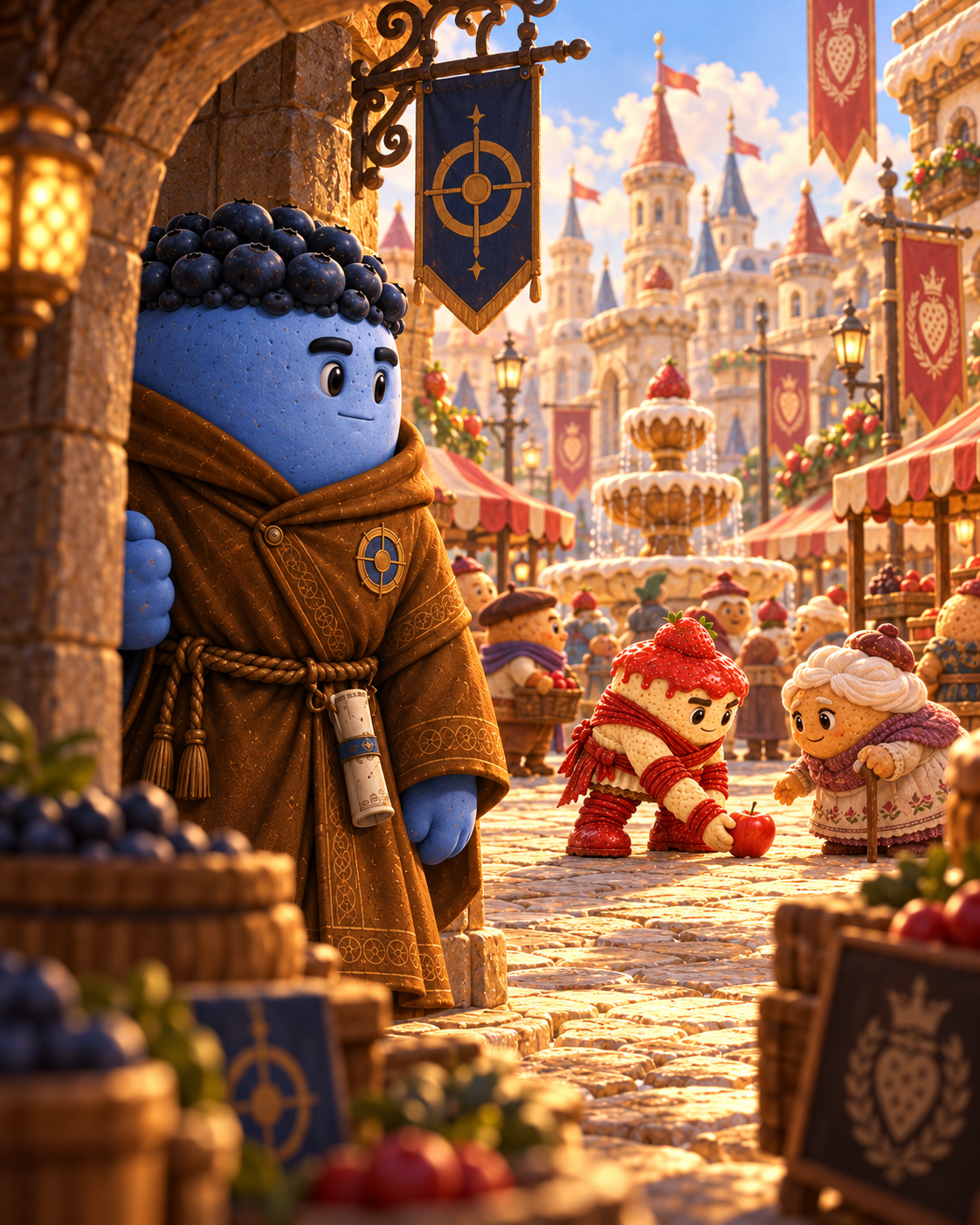
Strawbrawler noticed the blue cheesecake three streets later.
At first he thought it was coincidence.
Pastrypolis was full of people going in the same direction.
Then he turned left.
The blue cheesecake turned left.
Strawbrawler crossed the street.
A short while later, so did the blue cheesecake.
Strawbrawler entered a small shop.
He bought cord.
He came back out.
The blue cheesecake was standing beside a fountain.
Not hiding.
That somehow made it stranger.
Strawbrawler continued.
Two blocks.
Another turn.
Still there.
He stopped.
The large cheesecake stopped.
Strawbrawler stared across the street.
Blue body.
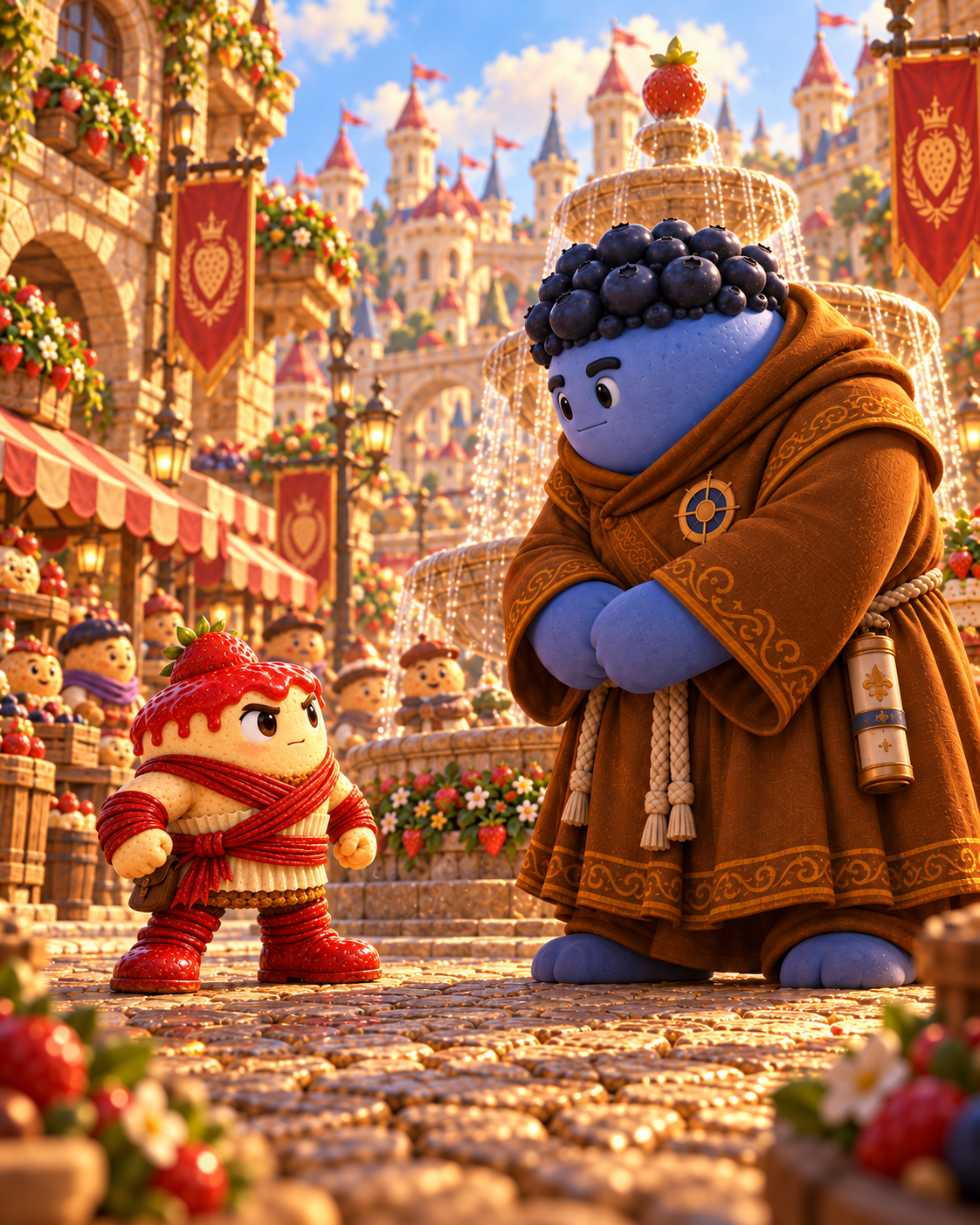
Caramel robe.
Blueberries.
Calm expression.
No attempt whatsoever to pretend he had not been following him.
Strawbrawler crossed the street.
Blue Bulk waited.
Strawbrawler stopped several steps away.
“You’ve been following me.”
“Yes.”
That answer caught him off guard.
Strawbrawler had prepared for denial.
He had not prepared for honesty.
“Why?”
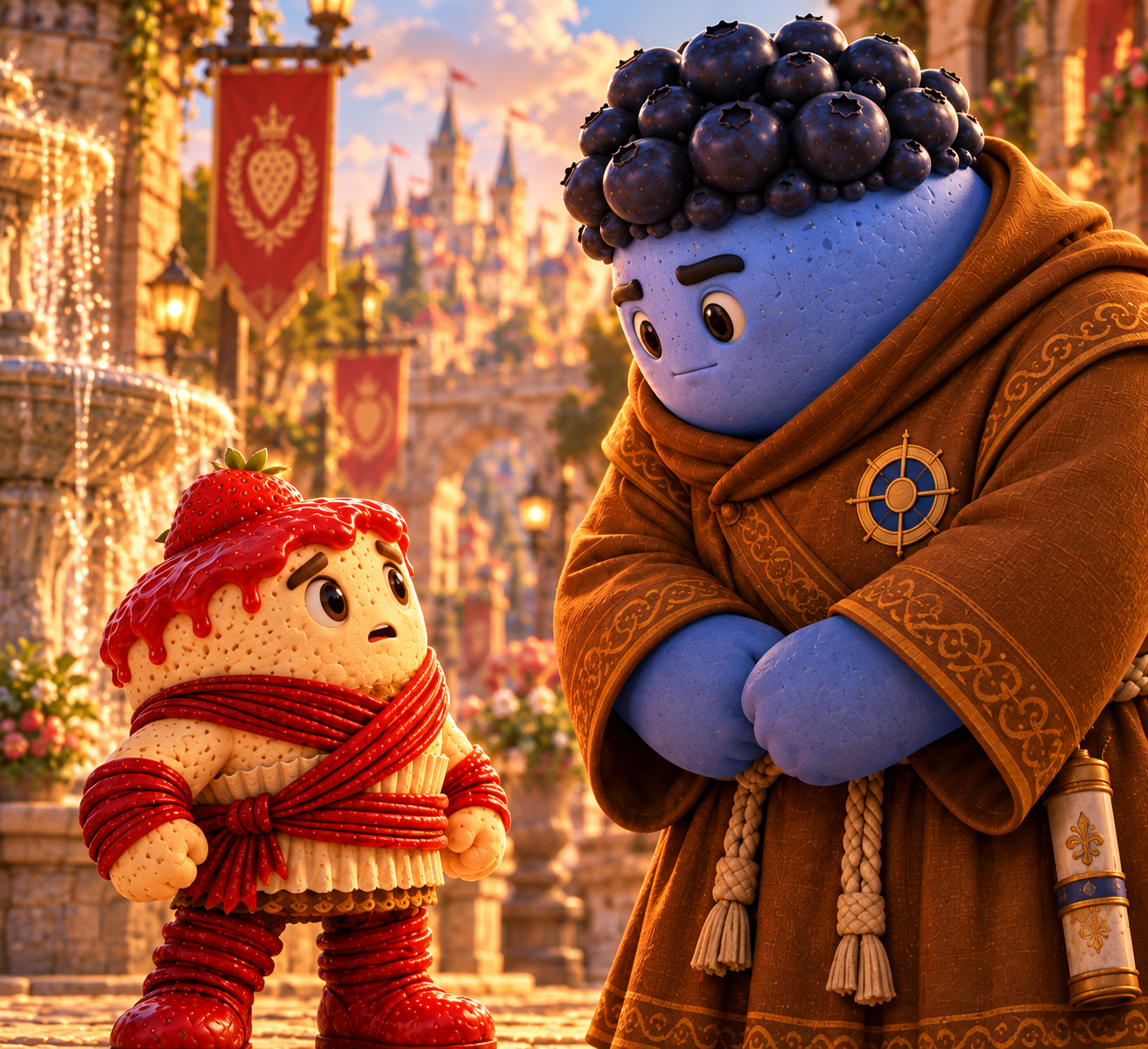
Blue Bulk looked at him.
For miles he had followed pressure through stone.
For days he had felt disturbances he could not explain.
He had expected to find a source.
Instead he had found a young cheesecake still deciding what his own name meant.
Blue Bulk considered his answer.
“I don’t know yet.”
Chapter 10 — The Weight Between Steps · Coming next

