CHAPTER 1
The Forgotten Dessert
The morning he lost his home, the little cheesecake thought he was ready.
He had known the day was coming.
Everyone at the children’s home did.
There was an age when you were no longer one of the little ones. An age when your bed would
eventually be needed by someone younger, when the lessons ended, when the rules said you were ready
to begin making a place for yourself in Pastrypolis.
Some left before then.
They found apprenticeships.
Workshops took them in.
Families made room for them.
Older brothers and sisters returned for them.
Sometimes a merchant needed a junior clerk, or a baker’s guild knew of a place for an assistant, or a
craftsman decided an eager pair of hands mattered more than experience.
The little cheesecake had watched plenty of them leave.
He always waved.
He always told himself his turn would come.
It never had.
Now there was no more time to wait for it.
His few belongings rested inside a small brown satchel on the bench beside him.
Two changes of wrapping.
A comb with three missing teeth.
A little polishing cloth for his strawberry glaze.
A worn city reader.
His papers.
And six silver crumbs the home could spare for his first few days.
The matron stood across from him with both hands folded.
She had already explained everything twice.
She explained it once more anyway.
"The recommendation is in the front pocket. Don’t lose it."
"I won’t."
"And your registration papers are behind it."
"I know."
"If somebody asks where you were educated—"
"Here."
"Yes."
"And you tell them you can read, write, and keep figures."
"I can."
"I know you can."
The little cheesecake looked down at his feet.
The matron stopped.
Her voice softened.
"You’ve been practicing this all week."
"I know."
"You’ll be all right."
He nodded.
He wished she had not said it kindly.
Kindness made leaving harder.
Around them, morning life moved through the home as though this were an ordinary day. Younger
desserts hurried down the corridor. Someone laughed in the dining room. A caretaker called after two
children who had forgotten their satchels.
At the far end of the hall, a little cream puff was complaining loudly about having to wash up before
lessons.
Yesterday, the cheesecake might have laughed.
Today, he found himself staring at the child’s shoes.
He had polished those shoes once.
The cream puff had cried after scraping one against a stair.
The little cheesecake had sat beside him until he stopped.
Now the cream puff still had a bed upstairs.
By evening, someone else would be sleeping in his.
The matron followed his gaze.
"There’s no shame in coming back to visit."
He looked up hopefully.
"Could I—"
Her face changed before he finished.
Only slightly.
But he saw it.
"During the day," she said.
"Oh."
"We simply don’t have the beds."
"I know."
"And if I bend the rule for you…"
"You’d have to bend it for everybody."
She smiled sadly.
"You were listening."
He tried to smile back.
The home’s front doors stood open.
Beyond them waited Pastrypolis.
He lifted the satchel.
For a moment it felt impossibly heavy.
Then he stepped outside.
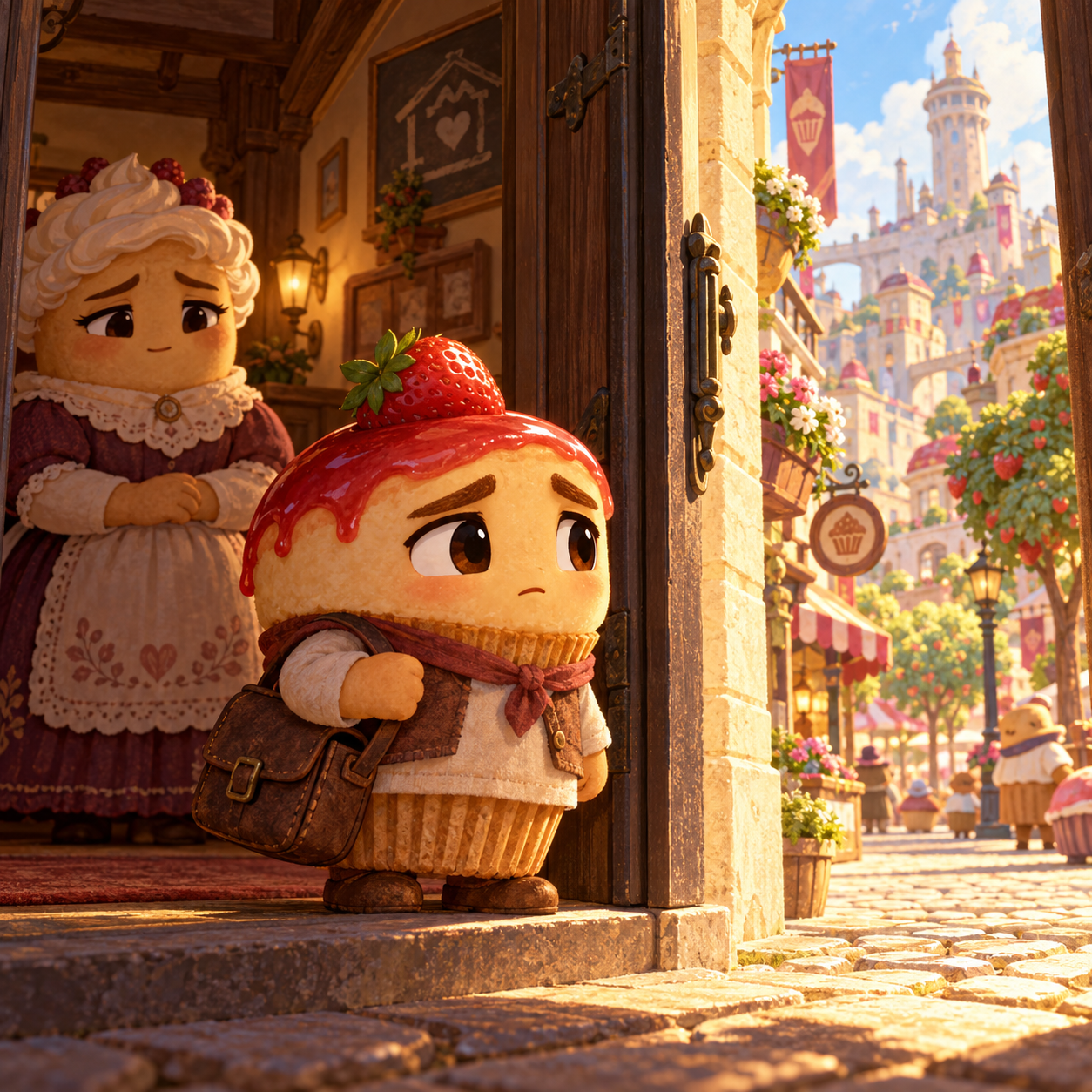
Pastrypolis looked particularly beautiful that morning.
He almost resented it.
Sunlight warmed the upper stonework of the buildings and caught along rows of windows. Flower
boxes spilled over balconies. Fruit trees lining the broader street had begun showing the first colors of
the season.
Farther above the roofs, one of the city’s old towers rose against the pale blue sky.
Carts clattered over cobblestones.
A handcrafted motor carriage passed with a low mechanical hum, its polished fittings flashing briefly in
the sunlight before it disappeared around the bend.
Shopkeepers raised awnings.
Workshop doors opened.
Delivery wagons rolled toward the markets.
Everybody seemed to be beginning something.
So was he.
That was what he told himself.
He had made a list.
The first address was only six streets away.
A cabinetmaker in Lower Pastrypolis needed a general workshop hand.
The little cheesecake had copied the notice down carefully three days earlier.
No experience required. Will train.
He had underlined those words twice.
By the time he arrived, his nervousness had almost become excitement.
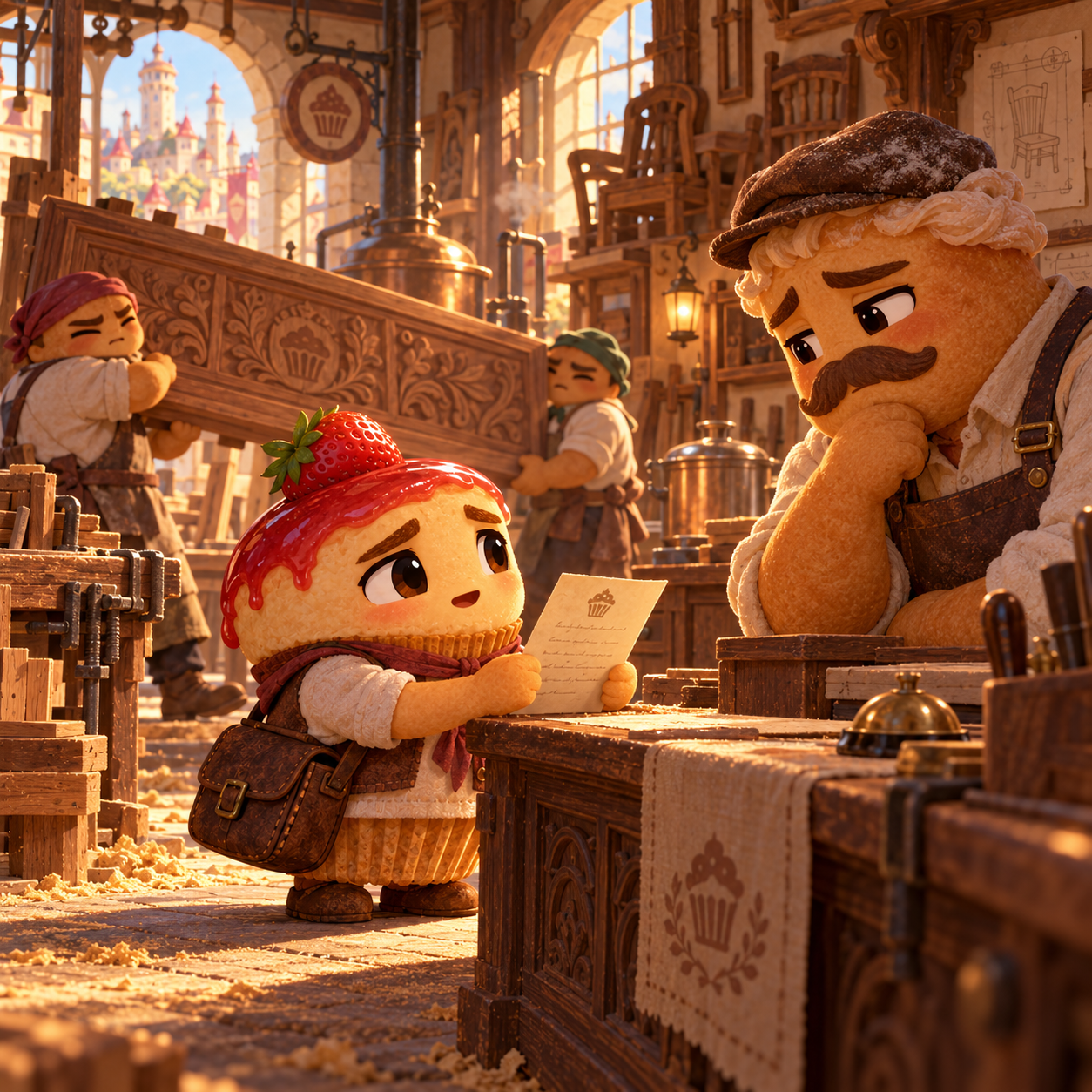
The workshop smelled of sawdust, varnish, warm glue, and something sweet simmering in a pressure
kettle toward the rear. Furniture frames stood along one wall. Half-finished chairs hung from pegs. Two
workers carried a long carved panel between them.
A broad pastry behind the counter looked up.
"Can I help you?"
The little cheesecake straightened.
"I’m here about the workshop position."
The proprietor glanced toward the notice in the window.
"Ah."
That was not quite the response the cheesecake had practiced for.
He put down his satchel and carefully removed the recommendation.
"I can read and write, and I’m good with figures, and they said I have steady hands. I haven’t worked in
a cabinet shop before, but the notice says—"
"No experience required. Yes."
The proprietor took the paper.
He read it.
The little cheesecake waited.
For a few seconds, everything seemed fine.
Then the proprietor looked over the counter at him more carefully.
The little cheesecake was small.
Even for his age.
His crust was uneven near the back. A faint crack ran across one side of his baked-cream body beneath
the strawberry glaze.
The proprietor looked toward the workers carrying the heavy panel.
Then back to him.
"This is hard work."
"I can work hard."
"I’m sure you can."
"I don’t mind lifting things."
The proprietor gave him a sympathetic look.
"Those two are carrying one of the lighter pieces."
The little cheesecake glanced over.
The panel was nearly three times his height.
"I could do other things."
"We need someone who can do all of it."
"I can learn."
"I believe you."
Hope flickered.
Then the proprietor handed back the paper.
"But I need somebody who can start useful today."
The cheesecake took the recommendation.
"Oh."
"Try over near the market. There’s always work moving in and out of there."
"Right."
"I’m sorry."
"It’s all right."
It wasn’t.
But the little cheesecake smiled anyway.
"Thank you."
He put the recommendation carefully back inside his satchel.
Outside, he crossed the first address off his list.
There were seven more.
The second place had filled its position yesterday.
The third wanted someone with prior warehouse experience.
At the fourth, a woman behind a shipping desk read his papers, then asked for an address.
"The children’s home," he said.
"For correspondence?"
"Well… until this morning."
She looked up.
"Where are you staying now?"
"I haven’t found a room yet."
Her expression became apologetic.
"We need a permanent address for payroll."
"I’ll have one."
"When?"
"As soon as I get work."
She hesitated.
The little cheesecake understood before she said anything.
"I’m sorry."
That made four.
He stopped counting after six.
By midday, the recommendation paper had developed a crease down the middle from being removed
and replaced so many times.
He bought the cheapest lunch he could find and ate it sitting on the edge of a public fountain.
He counted his remaining coins afterward.
Then counted them again.
Five silver crumbs.
He had planned to spend one of them on a room.
Maybe two, if necessary.
The rest would last until his first wages.
That had seemed like a lot of money when he left the home.
It didn’t anymore.
Across the square, workers were eating together outside a stone-cutting shop.
One of them told a joke.
The others laughed.
The little cheesecake watched them longer than he meant to.
Then he folded his list.
There were still two addresses left.
He got up.
The seventh employer didn’t look at his crack.
He didn’t ask about his size.
He barely looked at the recommendation.
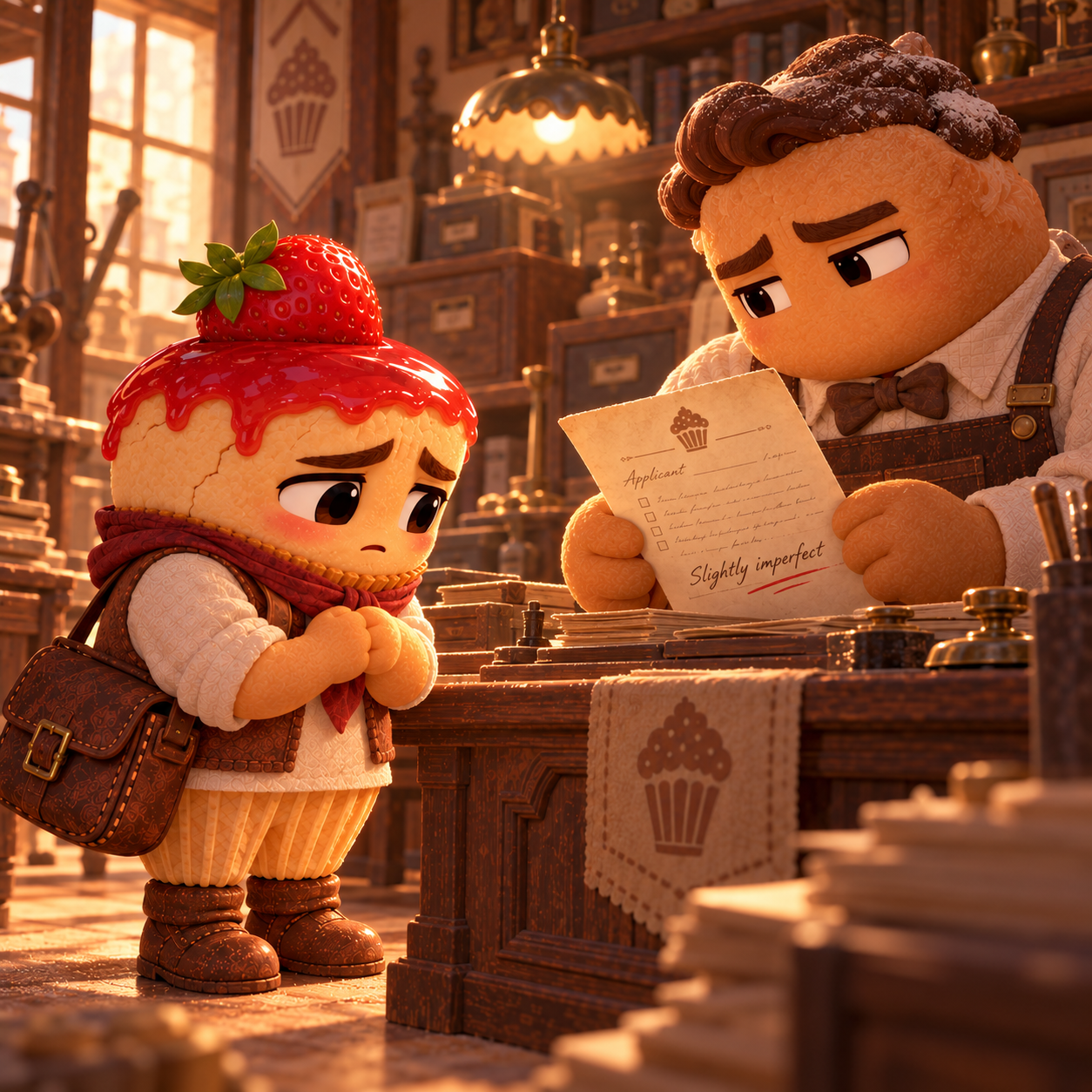
Instead, he pulled a pair of spectacles lower over his eyes and studied one of the older papers behind it.
"What’s this?"
The little cheesecake leaned closer.
Near the bottom of the page, beside an old intake notation, someone had written two words many years
ago.
Slightly imperfect.
He had seen them before.
He had never paid much attention.
"That’s just from when I came to the home."
"What does it mean?"
"I don’t know."
The employer looked at him.
Then at the crack beneath his glaze.
Then back at the paper.
The little cheesecake suddenly became aware of everything wrong with himself at once.
His uneven crust.
The strawberry that never seemed to sit perfectly straight.
His size.
That crack.
"It doesn’t stop me doing anything," he said.
"I’m sure it doesn’t."
The man kept reading.
"What exactly is imperfect?"
"I don’t know."
"Structural?"
"I don’t think so."
"You don’t think so?"
"No."
The man handed the papers back.
"We have machinery in the rear. Moving belts. Pressure tools. I’m not comfortable taking the risk
without a proper assessment."
"I’ve never broken."
The words came out before he could stop them.
The employer blinked.
The little cheesecake’s face warmed.
"I mean… I’m fine."
"I’m sure you are."
There it was again.
That sentence.
I’m sure you are.
Always followed by no.
"We can’t take everybody who asks."
"I know."
"I’m sorry."
The little cheesecake put the papers away.
Outside, he stood beneath the shop sign for several moments.
Then he crossed off number seven.
His pencil snapped.
The eighth address was gone.
Not the job.
The entire business.
The windows had been boarded over.
A faded notice read:
RELOCATED TO SAVARIN
The little cheesecake stared at it.
Then he started laughing.
He didn’t know why.
It came out once.
A tiny, tired sound.
Then nothing.
He sat on the curb.
Seven rejections and one business that had apparently fled to the coast.
He wondered whether that counted as eight.
Eventually he decided it did.
Finding somewhere to sleep would be easier.
That had been the plan.
Work first.
Room second.
He still had five silver crumbs.
There were boarding houses all through Lower Pastrypolis.
He chose one that looked modest but clean.
A brass bell jingled when he entered.
The woman at the desk smiled.
"Evening."
"Evening."
"Room?"
His spirits lifted.
"Yes, please."
"Just yourself?"
"Yes."
"Four crumbs for the week. One in advance."
The little cheesecake nearly sighed with relief.
"I can do that."
"Working nearby?"
He hesitated.
"Not yet."
The woman’s hand stopped above the ledger.
"New in the district?"
"Sort of."
"Where are you employed?"
"I’m looking."
"For how long?"
"Since this morning."
She studied him.
"I just left the children’s home."
Understanding crossed her face.
Not disgust.
Not irritation.
Something worse.
Concern.
"How much do you have?"
He didn’t answer.
Her eyes dropped toward his satchel.
"Four for the week," she repeated gently. "And then another four next week."
"I’ll have work by then."
"You might."
"I will."
She looked at him for a long moment.
He wished she would stop looking kind.
Kind people were becoming unbearable.
"There’s another boarding house three streets east," she said. "They sometimes rent by the night."
"How much?"
"One crumb."
That meant five nights.
Less, if he ate.
"Thank you."
"I’m sorry."
He picked up his satchel.
Everyone was sorry today.
Nobody could help.
The place three streets east was full.
So was the next one.
At the third, the nightly rate was two crumbs.
He stood outside that door until the lamps were lit along the street.
Then he walked away.
He didn’t know where he was going anymore.
Pastrypolis changed as evening settled over it.
Workshop doors closed.
Market stalls folded inward.
The smell of evening meals drifted through open windows.
Families crossed the streets together.
A father carried a sleepy tartlet on one shoulder.
Two young pastries chased each other around a fountain until someone called them home.
A shopkeeper swept his doorway and locked up for the night.
High above the roofs, the last sunlight caught the towers of the city.
The little cheesecake walked beneath all of it.
Nobody paid him much attention.
Why would they?
He was just another dessert carrying a bag.
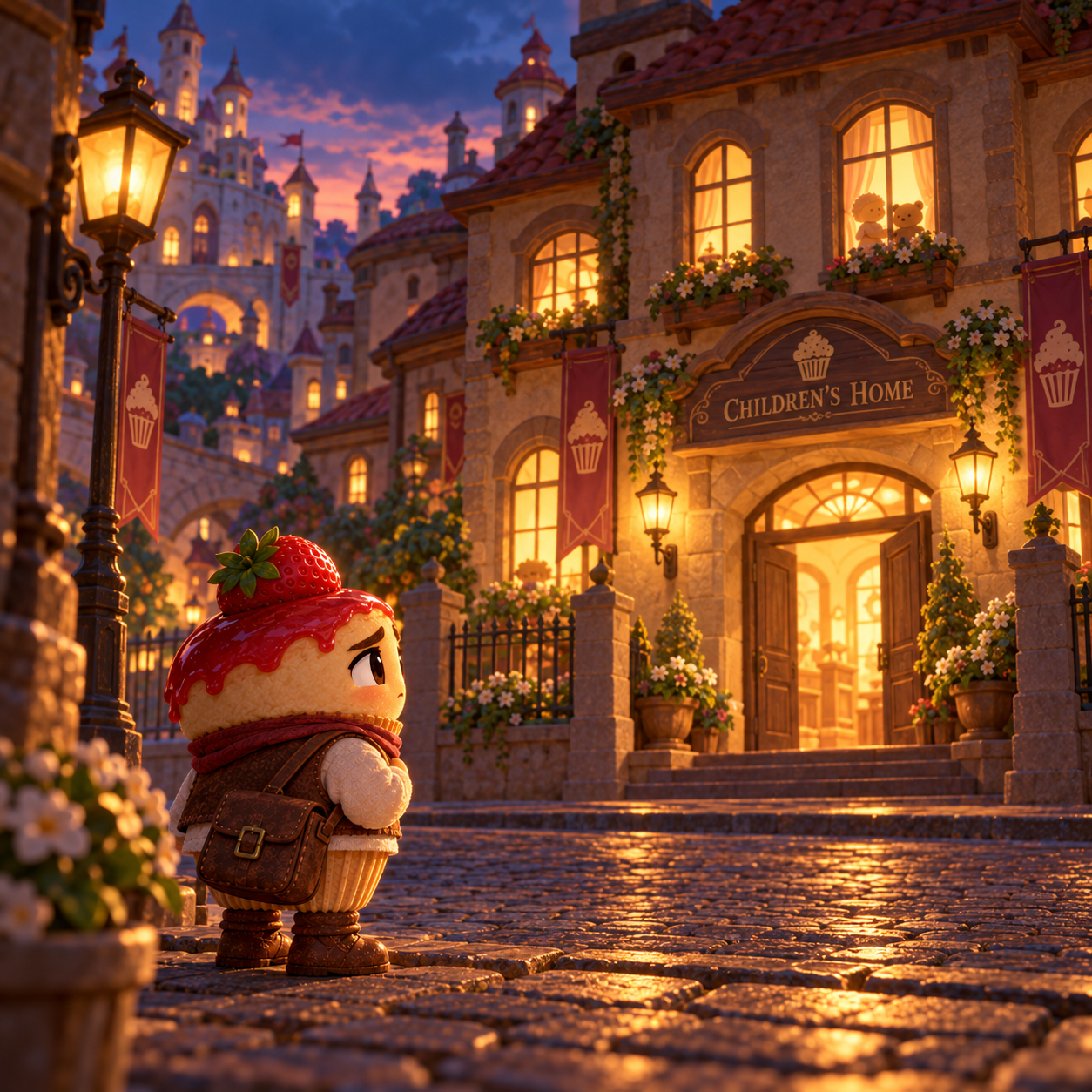
He passed the children’s home once without meaning to.
Warm light filled the upper windows.
He stopped across the street.
For one moment he imagined walking to the door.
He could knock.
The matron would answer.
She would be upset to see him.
Maybe she would find a blanket.
Maybe she would break the rule just this once.
Then he saw movement through an upstairs window.
Someone was already in his old room.
He looked away.
There were younger children.
They needed the beds.
He knew that.
Knowing did not make the pavement beneath his feet any warmer.
So he kept walking.
By the time he reached the older streets of the Crust, his feet hurt.
He found a narrow covered loading alcove beside a shuttered workshop.
It was dry.
Mostly.
There was an old crate he could sit against, and the roof blocked the wind from one direction.
He decided that was enough.
The satchel became a pillow.
His recommendation went back into the front pocket.
He took out his papers one last time.
Moonlight from the alley fell across the old intake sheet.
His eyes found the words without trying.
Slightly imperfect.
He ran one thumb over them.
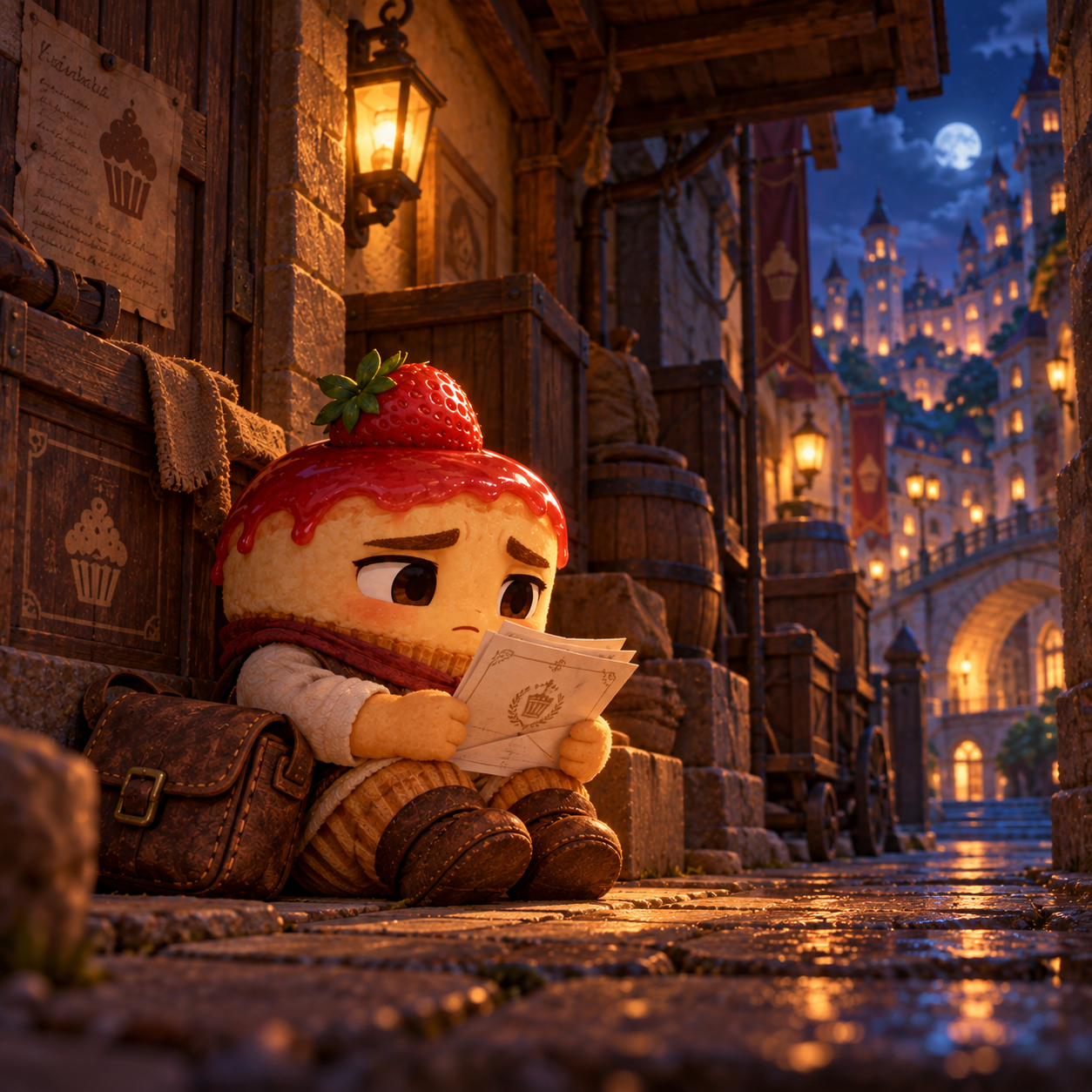
Seven employers.
Three boarding houses.
Five coins.
No job.
No room.
No home.
For the first time that day, there wasn’t another door to knock on.
Everything was closed.
There was nowhere else to try.
His throat tightened.
He folded the paper quickly and put it away.
He would not cry.
That lasted several seconds.
Then he curled around the satchel and cried as quietly as he could.
No one came.
Eventually the city grew still.
Somewhere beneath the cobblestones, old water moved through stone channels in the dark.
The little cheesecake lay awake listening to it.
He thought about tomorrow.
At first, tomorrow frightened him.
Then there was nothing else left to think about.
He wiped his eyes.
Adjusted the little strawberry on top of his head.
And whispered into the empty alley:
"Tomorrow I’ll try again."
He didn’t know that someone else would be waiting in the streets.
Someone who already knew what it felt like to be unwanted.
And who had learned a very different lesson from it.

